Friday, August 05, 2011

Following the Yanks to Falaise

I got to Isigny-sur-Mer in the corner between Omaha Beach and Utah Beaches about 4.30.  With my cousin's wine cellar a hour away in the opposite direction, I reluctantly concluded that Utah was a beach too far today and turned left to follow the US breakout route south.

The country close to the beaches was usually open but it changed completely when I left the coastal strip.  Much of the true bockage has been ripped out to widen roads, but enough remains to see what it was like.  The terrain is rolling hills, sometimes quite steep, with a patchwork of hedged fields and woods.  I've tried to take some representative photos to show what the ground is like.  Some things struck me as wrong about our FOW terrain:

We tend to have small isolated hills about the same size as fields and patches of woods or villages - all on a flat surface.  This doesn't happen in the bockage (and rarely anywhere else for that matter).  Hills are rolling ridges much, much bigger in scale than woods, fields or villages.

I stayed overnight with my cousin at Saint-Pois between Avranches & Vire.  The US came this way, but there was no significant battle there.

Next day I returned to Paris via Falaise.

To the east of Falaise, the terrain suddenly opened out into a big plain with wooded hills in the distance all around.


East of Falaise, about 5 K's short of Trun there was a memorial on a little rise with a view over the ground where the pocket was closed and very informative set of signboards.


These included boards showing the manoeuvres to here, then this excellent large scale map of the ground in front of you.  Battlefield hunting doesn't get any easier than this.


This is the German's road home.  The plain ends at Trun.   The hill on th left is Hill 26s where the pocket was formally closed when the Canadians met the Poles.


This overlaps the previous pic & is to the right of it.  This is the ground across which the Yanks, with it seems, Poles in the front, advanced (from right to left) to close the pocket.


On Hill 262, or Mont-Omel, there is a museum and a monument at the point where the pocket was closed.

There is a very cute M8 armoured car there.


And a very fine late model Sherman with 76mm gun & 7 armour.


And the view from the monument to the SW where the US came from is just brilliant.  (Click to enlarge).


And finally, the piece de resistance of the whole trip - le Tiger de Vimoutiers.  In the fighting to resist the closing of the gap this Tiger was abandoned by its crew when they ran out of diesel.  It remained in place damaged by its crew, souvenier hunters and scrap merchants until the local Marie took charge of it and scrounged enough bits of Tiger from elsewhere to make it pretty well whole again.


It stands by the road looking across the valley towards the Canadians.  I love this commander's eye view along that 88.  I've seen Tigers in museums before, but this is the first time I've been able to climb all over one.


It's interesting to compare this pic with the one in front of the Sherman above.  Fearsome as it is, the Tiger isn't actually any higher.

D Day Today: 6. Maisy Battery

Maisy battery is about 5km west of Pointe du Hoc and a couple of km inland.  It was buried by the local farmer after the war but rediscovered, excavated and then opened to the public in 2007.  It doesn't have big artillery bunkers with concrete roofs, its armament of 155mm howitzers and 37mm flack were in open bunkers.  Those open bunkers are exposed along with the support bunker system for accomodation, command, ammo storage and the interconnecting trench system.  Thus it is quite different to the other battery sites I visited and very informative. 


 This is a bunker entrance with the typical machine gun hole to protect it from infantry attack.

A "tobruk" machine gun post on the side of one of the bunkers.


An example of the information signs at the Maisey battery.  This one explaining what a tobruk is.  At this site they give you a map to self guide & you follow the arrows & the info signs are in French & English.


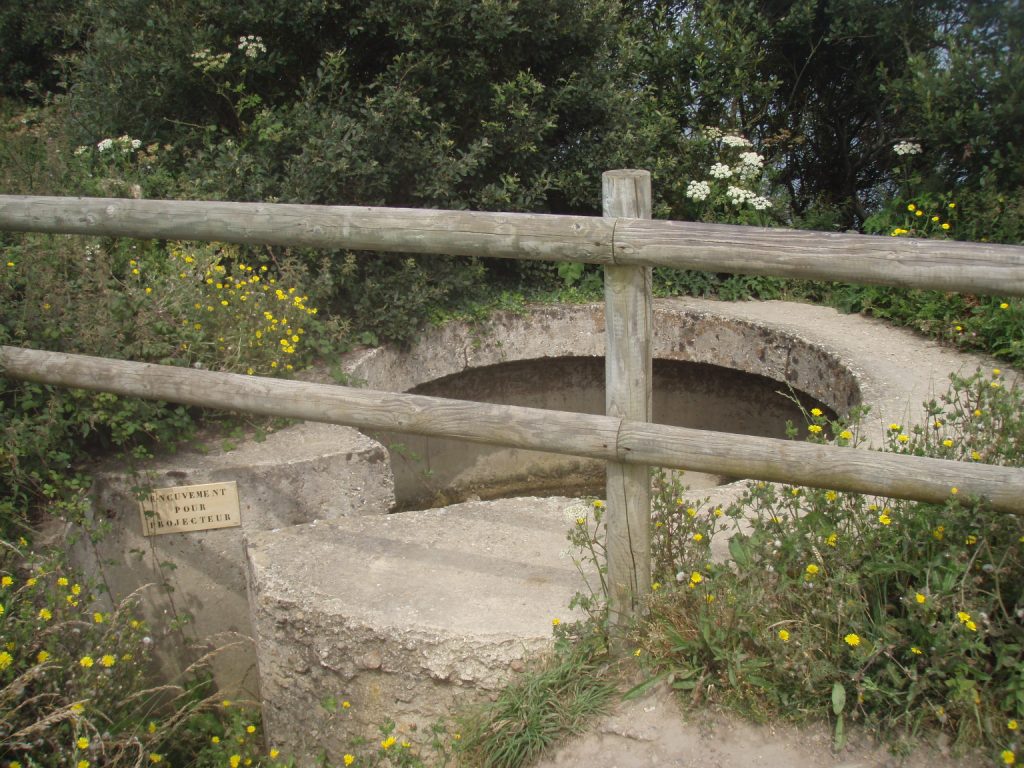
One of the 155mm gun emplacements.  This is a field gun from elsewhere put here to indicate the size of the original guns.  The original guns were mounted on steel turntables on the concrete base. 
They had no concrete lids here, just cammo nets,  but being in pits needed a direct hit to be taken out.


Thursday, August 04, 2011

D Day Today: 5. Pointe du Hoc

Pointe du Hoc has been cleaned up an opened to the public as a memorial to the Rangers who stormed it on D-day.  The site was a complex of bunkers with fields of fire extending over both Omaha & Utah beaches. 

The first pic looks west and Utah beach is about 15km away across the bay in that direction, but  too misty to see this day.


The airforces bombed the crap out of it before D-day.  Then on the day the navy took over, including USS Texas with 14" guns.  As a result the dominant feature of the site is not, as one would expect, the bunkers, but the craters.  The site is large and it almost covered by interlocking craters 12m in diameter and 5m deep - and that's after 66 years of erosion. 


All the monuments laud the yanks who attacked it, but what about the Germans who took this bombardment and were still able to put up a damn good fight in a hopeless situation ?


The main observation post on the point.  It has been substantially repaired.


A Machine gun nest.  Note the steel ring for mounting the mg for all round fire.


Typical gun bunker.  Most of the bunkers I saw followed a standard design as you would expect.  The gun postion with the overhanging roof, 2 ammo store rooms behind, then a protected exit at the rear covered by an mg port.
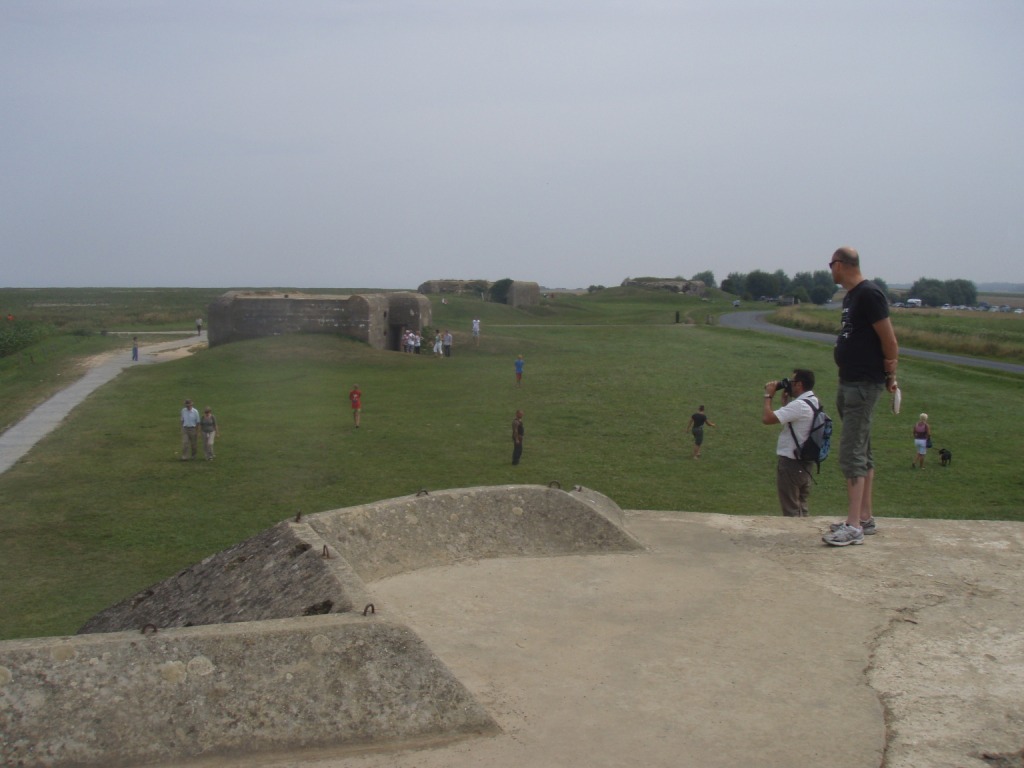


A bit of battle damage.


I assume this is what happens to a bunker when the USS Texas gets the range and fires salvoes of ten 1500 lb 14" shells.

D Day Today: 4. Omaha Beach

Omaha Beach looking west from about the middle.


The exit from the beach at Vierville-sur-Mer at the west end of Omah.  The was an anti-tank wall across it on D Day.  The bunker with a monument built on top on the right is a Pak 42 bunker.


The Pak 42 88mm anti-tank gun is still there behind a security grill.


The 88's field of fire down the beach.


A Mulbury harbour was installed at Vierville.  There is no sign of it on the water apart from some buoys marking harzards to navigation.  But a section of it is on display beside the road off the beach.


There are several museums and monuments in the area.  They often had some good stuff on display outside.  Here is a US 105 howitzer and a landing barge.


An 88 flak.


German 105 field gun and another landing craft.

D Day Today: 3. Longues Battery

The battery at Lonques comprises 4 casements for 155mm naval guns plus associated support bunkers all set in an arc about 300m back from the top of the cliffs west of Arromanches. 

About 6000 tones of bombs were dropped on it before D-day with no perceptable effect. 

On D-day it was engaged by ships of the French & British navies and put out of action. It did manage to force one ship to retire hurt, but the episode demontrates the superiorty of naval guns relative to air bombardment for bunker busting. The battery with just 4 guns was no match for several ships.   Even so, the bunkers show remarkably little sign of damage.  The eastern one is a shambles, but this is said to be due to an explosion of collected left-over ammo stored there after the battle.


All 4 of the original guns are still in their bunkers.   The other 3 have various degrees of damage but are basically intact, though they have been patched up a bit.


Ammo storage bunker.


There are small machine gun bunkers around to protect the battery and observation post from infantry attack.


The observation bunker on the cliff top.

D Day Today: 2. Sword, Juno & Gold Beaches

Hillman Fort

Hillman Fort is a small artillery fort located about 4 km inland from Sword Beach.  There is a monument to the regiment that took it. 

It is a group of about 20 bunkers - command, living, storage, observation and gun.

Its garison of 150 men held out through D Day but gave up the next day.

The ground around the fort and behind most of the length of the British beaches is mostly pretty flat and open.

Ouistreham

Ouistrham is the east end of the beaches.  The German command bunker has been turned into a museum.  There is some good stuff outside the bunker.

88 Flak.


25 pdr and landing craft - the very one used in saving Private Ryan.


Priest with V1 behind.


US half track.


Stuart.


Tank turret bunker.


Sword Beach.


A Pak 38 bunker on Juno Beach at St-Auban-sur-Mer.  Not how it presents a solid concrete wall to the sea side but can fire lengthways along the ebach in both directions.


A Churchill Arve as a regimental memorial.


The remains of the Mulberry Harbour at Aromanches-les-Bains at the west end of Gold Beach.

D-Day Today: 1. Pegasus Bridge

When I first visited the Normandy beaches in 1980 I was a bit disapointed at how few bunkers and relics I could find.  But things have inproved greatly in the last 26 years.  Many more bunkers have been either unearthered or had the scrub cleared away and been made accessable to the public.  The sites are now well signposted, both with direction signs and interpretation boards.  There are also many more museums and monuments.  I got a 7am start from Paris and reach my first objective, Pegasus Bridge  at 10.

This was the objective of a Brit para drop the night before D-day.  Was it Sean Connery who took the bridge ?

Pegasus Bridge looks exactly like Griggy's model.  I don't know how much of it is original, but the repairs pretty well maintain the design. 

The cafe beside the bridge is still there and still run by the same family as in 1944. 

The point of note is that the canal under it is a major obstacle - deep and wide.  The river a 100m east is much smaller. 


There is a CS Cromwell on the west bank as a monument.

Monday, August 01, 2011

The Somme Today

As motorway food is deplorable even in France we like to get off the motorway for lunch.  The Somme is conveniently located halfway between Brugge to Paris so we squeezed in a quick visit.  I'd been there before 3 years ago, but it was worth going back to see some of it in the sunshine and show Carmel where her grandfather was wounded in 1916 (as was mine).

We went to Pozieres for lunch stopping at the memorials to the 1st Australian Division (my GD's) and the 2nd (Carm's GD's) to look out over the battlefield.  It's gently rolling countryside, pretty as a picture in the sunshine (the sun appeared soon after we left Belgium).  It's hard to imagine it as a morass.

Like Ypres, the area was got back into farming production asap and there are only limited remains - the odd delict bunker or crater hole in a field or next to a monument.  And of course cemetaries and monuments everywhere.  But the area is better signposted than Belgium.  Since I was last there signs noting where the front was a certain dates have been placed beside the Albert Road.  These are a great help in getting a feel for the scale of the action and the speed of the advance (slow).

The 1st pic is the 2nd Div monument, the 2nd, the 1st Div's, the 3rd, the view north from the 2nd Div monument just north of Pozieres.  This the direction of the Australian attack from here.  I could have made a panorama, but it's much the same for 360 degrees.


We did lunch at "Le Tommy" Restaurant & Museum in Pozieres - a shameless piece of kitch aimed at  commonwealth visitors, but it was actually entertaining and not bad food.  We wondered if our grandfathers lived it up here in 1916 before being wounded & sent to Britain to recover.  Fortunately both our grandfathers missed out on the 1917 madness.  Mine got a cushy job training new recruits in Britain.  By the time Carm's pop had recovered, deserted, been caught & seerved his time in jail Paschendaale was all over.  They both must have been so disappointed.  But they were both back in it in 1918 doing their bit in Monash's victories further south.