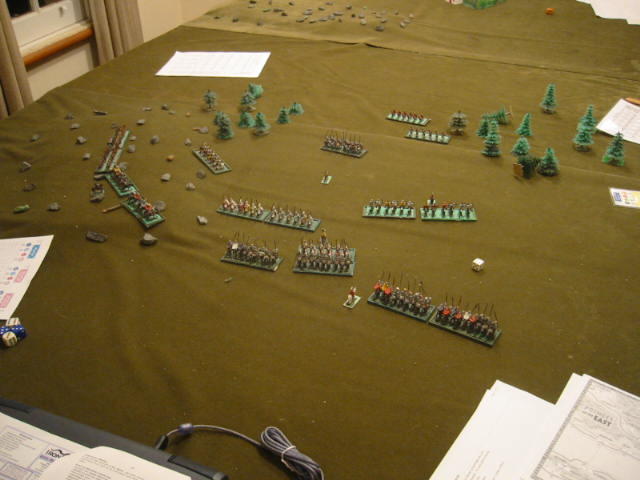
Battle Report from our man on the Ground somewhere in Italy
(WARNING: this report is subject to military censorship and any omissions, inaccuracies or wild opinions found within are totally the fault of the censors)
As elements of the crack Bavarian Battalion surge south in a concerted counterattack, a scratch british force was quickly assembled and dug into prepared positions in an attempt to blunt the sharp Bavarian steel.
A 2,000 pt battle fought under the Flames of War rules contested by a German High command consisting of Steve and Leigh while Jim and Barry held the British line together.
The scenario played was “The Big Push” where the British pre-deploy over half the battlefield entrenched. Half the British force is held off-board as reserves and are expected to start dribbling onto the battlefield from turn 3 onwards.
The Germans have the advantage of an initial bombardment, which affects every British unit and ensures that the entire British onboard force begins the game pinned.
In order to win the Germans must capture one of two objectives and as a bare minimum have units on the British side of the board by turn 6.
A quick glance at the board (see photo) shows a variety of terrain. However, the salient features are the defensive Linguini Line that traverses the middle of the board and consists of an initial field of mines backed up by two lines of wire with a few extra mines thrown in. The two objectives are positioned on raised ground behind the Linguini line - one to the left (“Ravioli Ridge”) and the other to the right. As shall be seen from reading further all the action was centred on the left of the board and Ravioli Ridge.
The British deployed an entrenched line of infantry directly behind the Linguini Line and a double battery of 25 pdrs on the crest of Ravioli Ridge, which were also entrenched. On the right hand side of the board a battery of 17 pdr anti-tank guns were entrenched on the second objective hill. In reserve were a platoon of Grants, another of Crusaders, some infantry and a swarming mass of Bugs (Bren gun carriers). Nobody was expecting the British reserves to arrive in any coherent manner.
Pre-Battle InterviewThe German High Command graciously gave our intrepid reporter access to their inner sanctum prior to the battle in order to show how an efficient, well run, co-ordinated command plans its attack. I must state for the record that it was an enlightening experience.
At their disposal, the Germans had a platoon of Pioneers, two of motorized Panzer Grenadiers, an artillery battery (10.5cm), a mortar platoon and a Panzer III platoon. The entire German formation started the game on the board and were free to deploy anywhere on the German half of the table.
After some discussion the agreed upon strategy was to totally ignore the right hand objective and to focus the entire attack on Ravioli Ridge.
The ease and discipline with which this decision was reached was a salutary lesson for all battlefield tacticians in how a well functioning team operates. Our reporter was mightily impressed.
Having locked the big picture firmly into place the German High Command, confident they had a game winning strategy, switched their focus to the means required in order for victory to occur.
And alas poor reader, it was at this point that the fast moving KubelWagon that was the German High Command operating at peak performance slewed off-track into an uncontrolled skid. Asked what the plan was for breaching the minefield our reporter was stunned to see orderlies rushing forward with rule books frantically flicking pages looking for the effects of minefields and wire. Animated discussion ensued with the conclusion being that it would left to the Pioneers to create the mighty gap in the Linguini Line that would allow the German war machine to reach out and stomp somebody.
When queried about what would happen if the solitary platoon of Pioneers didn’t create a gap before being blown to bits (the High Command’s best guess as to their future prospects) our reporter was told that there was no plan B.
“We’re screwed”
It was Pioneers or bust.
Given that the cream of the German High Command had a full week to plan their assault and that the minefields were a known factor, this left our reporter somewhat puzzled and rather dubious about the German’s prospects in battle.
Unfazed the High Command proceeded with a precision deployment of troops with everything bunched up behind the Pioneers ready to rush through the gap they would – maybe – create.
The German artillery deployed to the rear and the mortar platoon as far forward as possible whilst still being out of sight. These fire support placements were key to the Germans ability to dominate the artillery battle.
Taking his leave from the German High (‘Confused’ is more like it) Command (perhaps ‘minefield’ is not in the German vocabulary…) our reporter trudged south in order to share tea and biscuits with the British. While warmly welcomed unfortunately neither tea nor biscuits were offered, something that has been noted in dispatches. I’m sure that CNN reporters don’t have to put up with this kind of shit.
The British strategy was to first duck, cross their fingers and hope that the initial bombardment didn’t do too much damage. Once the storm had been weathered it was a case of “Hold the f…s off until the reserves arrive”.
Mmmmm.
Hoping for something a little more enlightening, this reporter questioned the British Command Group on their plans for the reserves. After several furtive glances I was informed that the bugs were for suppressing an infantry attack and the tanks were for suppressing a tank attack. Clearly, the British Command were operating on a need to know basis and they were of the opinion that this reporter was best left hungry, thirsty and ignorant of the master plan. Given this and the distinct – and noticeable - lack of refreshment, this reporter left none the wiser. If the German bombardment wiped the board of these stingy, tight-arsed tea and biscuit withholders then he wasn’t going to shed any tears.
Turn 1 and 2 – The Pioneers Tragic EndThe preliminary bombardment was something of a fizzer. Only an artillery observer and one 25 pdr gun were destroyed, however as already mentioned the entire British force started the game pinned as a result of the incoming artillery fire. (Whether a more effective initial bombardment would have had any bearing on the game outcome given what transpired is a matter of some debate but our reporter thinks not.)
The Germans prodded the Pioneers forward at the point of a bayonet (see below) and prayed.
Steve “I forgot to do my stormtrooper move”
Leigh “So what. Where are you going to move to?”
Was this the first sign of cracks developing in the German High Command?
The pioneers, damned and doomed, cursed the Fuher, conspicuously mooned the German high command (see photo) then stoically marched up over the crest of the hill to their death. As they bent to the task of clearing the first line of mines, artillery shells and infantry fire thinned their ranks. Fumbling and hung-over from last nights schnapps binge with the Panzer Grenadiers (‘tonight we drink for tomorrow we die’) the few surviving pioneers self-imploded themselves clear over the cliff edge to hell.
But all was not in vain. As the last pioneer smeared blood and bone over the landscape like a madman attempting to butter his toast with Satan’s fork, a sigh of relief went up from High Command. There was a gap in the minefield! No, not the expected autobahn highway to victory but a small, snaking path through the hidden dangers lay open before the might of the Reich’s men from Bavaria. ‘Onward, mein brave soldiers, onward!’
A highlight of turn 2 was UberLeiutenant Steve claiming that his last remaining Pioneer squad was counted as concealed as it was standing behind barbwire. Given the fate of the rest of the platoon this was an understandable gesture. Or was it guilt?
The German artillery commenced their methodical destruction of the 25 pdrs and a second gun was destroyed.
Turn 3 - A cautious advanceAfter multiple theodolite checks, Herr General Leigh advanced the four Panzer III’s through the gap and into the belly of the Linguini Line. The few surviving, badly wounded, pioneers were summarily squashed underneath by the tracks of the tanks.
The Panzer Grenadier platoons were held in reserve while UberLeiutenant Steve’s artillery pounded Ravioli Ridge yet again. Another two 25 pdrs bit the dust to the guns of the Panzers and the mortar platoon forced the British infantry to grovel around in the bottom of their trenches.
The British failed – yet again – to unpin their remaining 25 pdrs and it was a case of bite your fingers and hope for better things as the Panzers loomed large. A couple of guns did manage to fire over open sites but in their frazzled state it was a case of loud bangs only. Captain Barry, in charge of the anti-tank battery on the right hand hill, ordered chocks to be pulled and all hands to the guns as they were manhandled out of their entrenchments and repositioned to cover the advancing Panzers.
Major Gandy yelled down the radio for reinforcements but there was no reply. Were they all sitting around having tea and biscuits I wonder?
Turn 4 – Panzer terrorAs turn 4 began the German High Command retreated under the ‘cone of silence’. A short, sharp debate ensured over whether the fire support should target the juicy 17 pdrs being manhandled in the open or continue the suppression of the 25 pdrs on Ravioli Ridge. General Herr Leigh, his exposed Panzers staring up at the barrels of the 25 pdrs declared his need was greater and UberLeuitenant Steve reluctantly agreed.
Herr General Leigh was in the thick of it and having to fight for artillery support was the least of his worries. What should he do with his four Panzers? Directly in front of them were a short field of mines and yet to move to the right in order to bypass them would expose the flanks of his Panzers to the 17 pdrs. Decisions, decisions.
After much thought and some extended precision theodolite work, two Panzers were sent slightly to the right in order to punch straight through the two lines of barbwire in front of them and skirt the minefield. One Panzer made it through but the other unfortunately failed a bogging roll and became hung up on the wire. The remaining two Panzers, whilst urged onwards by the rest of the German Army, chose to remain stationary in the middle of the Linguini Line and provide moral support to the sole Panzer that had broken through. On a crackling radio line when our reporter managed to ask Herr General Leigh why he didn’t advance all three Panzers he was told that… “I’m not that stupid” (Admittedly it there was a lot of static on the line and the question may have been misunderstood)
Sergeant Steiner, commander of the lead tank in Panzer Platoon ‘A’ quickly glanced through the turret viewfinder. His tank was the only one through the Linguini Line and before him lay dug in tommies and behind them Ravioli Ridge, their objective.
“Schnell, schnell Hans! More revs! Forward!”
“Herr Steiner, high command wishes us to move to the right”
“What is this Gustaff? The tommies are to the front!”
“Herr Stiener, high command now wishes us to move to the left”
“Gustaff, are you drunk?”
“No Herr Stiener, high command … wait … they now order us to the right again”
“Gustaff!”
“Yes Herr Stiener?”
“You have your luger with you?”
“Yes Herr Stiener…”
“Then Gustaff, shoot ze radio dead”
“Ze radio Herr Stiener? How can we talk wiz ze high command if I shoot ze radio?”
“Gustaff, we are Panzers, not puppets. Shoot ze fucking radio NOW!”
“Herr Stiener! Anti-tank guns have opened fire on our flank!”
“Herr Stiener, I hear tanks approaching!”
“Herr Stiener, high command order us to retreat. No, no! Now they order us to advance!”
“Herr Stiener, what are you doing with my luger? This is a loaded weapon, Herr Stiener. High command would not approve.”
“Gustaff”
“Yes, Herr Steiner … No, no, I implore you Herr …”
Bang.
The German fire support had it’s sole dud turn the entire game and managed to drop a rainstorm of metal on vacant real estate.
Belatedly coming to grips with the situation, Herr General Leigh stormtroopered the sole Panzer directly into the entrenched infantry line and succeeded in routing the entire left platoon from the cosy, tea and biscuit supplied, trenches.
The only anti-armour weapon in the entire entrenched line (the ‘Boys Anti-tank gun’) was, predictably, somewhere else on the day, no doubt having its barrel oiled.
The British, faced with a rampaging sole Panzer at the foot of Ravioli Ridge, tensed up. There was friction in the camp as Major Gandy considered retreating the remaining 25 pdrs off the ridge to safety. As luck would have it 3 Grants charged up from the rear (double move) and stiffened the defences. Major Gandy, however, still favoured the retreat. Captain Barry risked a court martial by derisively commenting to his commander…
“It’s only one tank. Don’t you think you have enough firepower already?”
And thus the matter was resolved. Our intrepid reporter put Major Gandy’s momentary lapse of judgement down to an excess of tea. It does that you know. Drink too much and you start seeing fairies.
In other events Captain Barry continued manhandling his 17 pdrs into position.
Turn 4 can be considered the fulcrum point of the battle. The Germans had broken through the Linguini Line and the British were all a dither attempting to consolidate their defences.
Opportunity beckoned with Ravioli Ridge wide open and German fire support rampant.
Unfortunately, the German High Command traded aggression for caution. The sole Panzer that had broken through the infantry declined to advance further during its consolidation move as…
“Where can I go? There is nowhere I can hide now!” Herr General Leigh. The two unbogged Panzers were left idling their motors back in the middle of the Linguini Line…
“Which way can they go? I can’t go there” Herr General Leigh
The Panzer Grenadiers (two platoons) remained sipping Schnapps in their transport way back over yonder.
Our reporter found Herr General Leigh’s concern for the welfare of his troops admirable and, despite the fact the whole lot of them got blown to buggery not long after as a direct result of his caution, I’m sure they all appreciated it. It should also be noted that it is easy to report from the sidelines when you aren’t confronted by the need to make decisions under fire.
Herr UberLeiutenant Steve, sensing victory slipping through German fingers, took it upon himself to move the entire German rear forward during the British turn, claiming he was making his famous ‘Stormtrooper move’. A valiant gesture that was chopped off at the legs by the umpire.
Turn 5 - The Tide TurnsLuck was with the Germans as they unbogged the Panzer in the wire and suddenly they had four mobile, active Panzers close to the objective. Pessimism, however, ruled the day. The German High Command lost the plot altogether…
“What the heck are we going to do now?” Herr General Leigh
There ensured a solid five minutes of thrashing the theodolite to death, moving tanks all over creation, muttering, re-positioning tanks all over creation, more muttering until eventually all four tanks were pointed at the objective and reluctantly shuffled forwards a little. God was watching (probably bug-eyed in amazement like your reporter) and immediately bogged one of the tanks crossing the captured entrenchments at which point the remaining two downshifted and sat staring at obstacle, too frightened to cross.
At the urging of UberLeuitenant Steve, the Panzer Grenadiers finally mounted up and headed for the gap in the Linguini Line to exploit the breakthrough. For reasons unknown they stopped short of the gap, dismounted and prepared to proceed on foot.
Dark clouds hovered overhead. Lightening and thunder crackled throughout the sky. The earth shook. The Gods of War were mightily unhappy.
Even the forceful stormtrooper move at the end – an opportunity to move closer to the objective – was wasted…
“Forget the Stormtrooper move, we’ll be sitting ducks” Herr General Leigh
While the reader probably has an inkling that our reporter had a dim view of proceedings it is important to remember that even the best generals in the world have their off-days and it was Herr General Leigh’s misfortune to have a Reuters reporter nearby at the time taking copious notes and photographs of proceedings. This in itself would be an unnerving experience and prone to put many a fine tactician off his weetbix. I shall state for the record that Herr General Leigh is a fine man, an excellent general and wields a mean theodolite. He is not a man to be trifled with and I sincerely hope that he keeps uppermost in his mind the extensive legal resources available to the Reuters organisation.
It was right about now that UberLeiutenant Steve added to the bad karma on the German side of the board by breaking wind more or less continuously. Gas masks were issued. The karma was now not only bad, it stank. Your reporter pretty much gave up on the whole deal and sat through the rest of the battle slumped in his chair, semi-comatose and dying of thirst.
Remaining movesWhat is there to say? The remainder of the British reinforcements arrived and consolidated their defences (see photo below). The Panzers were picked off by the 17 pdrs. The German artillery completed their destruction of the remaining 25 pdrs.
The two companies of Panzer Grenadiers plodding through the Linguini Line on foot proceeded forward while the German anti-tank platoon (a couple of PAK’s) unlimbered in a big hurry on the crest of a hill on the German side of the Linguini Line. They were just in time as an armoured/bug counterattack was launched against the Panzer Grenadiers. Two Grants blew up in short order and the rest of the British armour retreated to lick its wounds.
A dilemma for the British ensued, as they had no artillery with which to neutralise the PAK’s and any armour that showed its face was liable to go the same way as the Grants. Meanwhile one platoon of Panzer Grenadiers made it into the recently vacated entrenchments. Trench warfare ensued with the British and German infantry duking it out along the line of defences. At one point Captain Barry sounded the retreat but was overridden by Major Gandy who initiated a general infantry assault from two directions. This eventually wiped out both platoons of Panzer Grenadiers and brought a battle which had been on life support for some time to a late end.
ConclusionsThe Linguini Line proved to be a major obstacle to the attackers.
The German strategy of making only one break in the defences allowed the British to concentrate their entire force against a solitary choke point. The same choke point greatly disrupted the Germans movement and their piecemeal attacks were easily beaten back by the reinforced British line.
The German’s woes were compounded by an overly cautious exploitation of the breakthrough. Outright aggression was called for in order to grab the objective before meaningful British reinforcements arrived.
The German artillery dominated the battlefield. They completely negated the British artillery and created havoc amongst the British forces. German fire support couldn’t on its own prevent defeat but it significantly prolonged the decision.
AnalysisThe German’s woes can be directly attributed to their choice of army. The fact that this is the first time that this scenario has been played makes the German High Command effectively test pilots and their best guess as to army composition on the night would have been as valid as anyone else’s.
However a few observations can be made.
Faced with the need to punch a hole through the Linguini Line the reliance of the Germans on a solitary Pioneer platoon was fatal. Having all their eggs in one basket ensured that they could only ever threaten one objective and if their pioneer platoon failed in their task (which they very nearly did in the game) it would have been all-over-red-rover by turn 2.
Swapping a Panzer Grenadier company for a second Pioneer platoon would have been a better option enabling them to threaten both objectives. Even if one thrust was only a feint it would have split the British defence and given them things to think about.
While on the subject of infantry the Germans had two fully motorized Panzer Grenadier platoons who were forward deployed and positioned to support the tanks in their assault through the expected Pioneer-induced gap in the Linguini Line. In the game the German High Command actually dismounted the Panzer Grenadiers and walked them through the gap. By the time they made it through the Panzers they were there to support had been destroyed and the British had reinforced the objective. It was only the dominance of the German fire support that prevented them from being quickly over-run and annihilated. Hindsight would indicate that there was little point in having fully motorised infantry if you aren’t prepared to use them as such.
Looking at the bigger picture, relying on vulnerable motorised Panzer Grenadiers to funnel through a solitary chokepoint under heavy fire in order to reach the objective was futile. The nature of the scenario dictated an aggressive in-your-face assault by the Germans. Infantry rushing straight towards the enemies lines in soft-skinned transport is akin to the charge of the Light Brigade.
The German panzer platoon of four Panzer III’s proved effective in punching through the Linguini line and exploiting the breakthrough once there was a line of travel through the initial minefield. On two occasions, the tanks became bogged, once going through the wire and once assaulting the first line of entrenched infantry. Neither situation impeded their progress for long. Cautiousness did, however, prove fatal.
A second platoon of German Panzers, wielded aggressively, would have likely proved decisive despite the limitations of the German position. In a situation where time and mobility were the key, armour was the only way to go.
There was one area in which the Germans excelled - Fire Support. It is worth delving deeper into the reasons for this as it wasn’t simply a case of bad dice versus good dice. The Germans rear deployed their heavy artillery battery and forward deployed their mortar platoon. Both were situated behind hills and out of sight from any British observers who were essentially static for the duration of the game. This ensured that they were immune to counter battery fire and could happily blast away with impunity from start to finish, something they went to with a relish.
The British, on the other hand, positioned their double battery of 25 pdr’s on the crest of Ravioli Ridge. This gave them the option of direct firing at any German units attempting to breach the Linguini Line on their side of the board. The same visibility that gave them the direct fire option proved to be their Achilles heel. The Germans methodically pounded them into oblivion and by turn 7 they were gone. From the start of the game until their demise, they were pinned. This pinning was sufficient to neutralise them as an effective fighting force on the many turns when no guns were actually destroyed.
If the 25 pdrs had been deployed behind Ravioli Ridge instead of on top they could have continued to be an effective force and in all likelihood the game would have been over early. The Germans would have been unable to walk large clumps of infantry through the Linguini chokepoint and the anti-tank platoon they deployed with such effect on the crest on the German side of the Linguini line would have been easily neutralised.
Lastly, the British positioned a continuous entrenched line of infantry directly behind the Linguini Line that stretched from one side of the board to the other. This proved brittle and of little impediment to the German panzers. This same line of entrenchments actually served to prolong the pain, as the Germans were able to insert a platoon of Panzer Grenadiers into the recently vacated entrenchments and proved very hard to remove.
AwardsHere at Reuters we take our war reporting seriously. Too much death and destruction, however, depresses our readers. After much discussion at News Central, we have come up with the following awards…
The man-of-the-match award goes to Herr UberLieutenant Jendriks for some kick-ass fire support.
The Golden Theodolite goes to Herr General Leigh for a succession of precision, theodolite-aided moves that greatly enhanced the well-being of the troops under his command.
Herr General Leigh also takes down the “Pass-the-buck” award for his analysis of what went wrong stating…
“Steve threw some very ordinary dice”
The British 25 pdr battery crew have won the lead limp appendage trophy for the unit with the most potential that achieved the least.
The German Pioneers are to be court-martialled in absentia for mooning the German High Command prior to their suicidal foray into the minefield. The Reichstag wishes it to be known that mooning is not an approved German Military Manoeuvre.
The Bren carrier Bug Platoon (all eight of them!) win a complimentary wooden duck award for their effort in lining up, side by side, parade ground style in order to generously give the German artillery some easy target practice.
The Iron man award goes to Captain Barry of the Bulldogs who manfully leant his shoulder to the task of redeploying all four 17 pdrs by sheer grunt alone.
The entire Panzer III platoon gets a traffic citation for confused driving. Rumours abound that they will have their tank licences pulled and be reassigned to donkey duty in Mesopotamia.
Finally, Major Gandy and Captain Barry have both been cited for sustained sledging of the opposition. Gentlemen British officers are expected to behave with the dignity that befits their position. Comments such as…
“I thought that the Germans were meant to be decisive” (Major Gandy)
“Not this lot” (Captain Barry)
reflects badly on the profession and only serve to upset an already depressed opposition. Sportsmanship chaps, sportsmanship.
Cameron Harris
Rueters Stringer and Our Man On The Ground
Italy